Vietnam premier urges greater efforts to protect national sovereignty

05:36 |
TUOITRENEWS
UPDATED : 07/01/2014 16:51 GMT + 7


Vietnam’s Prime Minister Nguyen Tan Dung has emphasized the need that the government should make more efforts to protect national sovereignty as China has broken international law to maintain its illegal Haiyang Shiyou 981 oil rig in Vietnamese waters.
The government leader made the call while chairing the cabinet’s regular meeting on Monday to review social issues, national economy, security, defense and external relations in the first half of 2014 and outline major tasks for the rest of the year.

Addressing the teleconference, which was attended by leaders of localities nationwide, PM Dung said the meeting took place at a time when China has illegally placed its drilling rig in Vietnam’s waters since May 1 in defiance of international law, morality and the Vietnam-China friendly relation.


This act has not only violated Vietnam’s sovereignty, sovereign right and jurisdiction and affected the relationship between the two countries, but it has also threatened peace, stability and security in the region, the leader said.


Thus it is crucial to exert every effort to safeguard national sovereignty by peaceful measures based on international law, and at the same time maintain an environment of peace, stability and security for the sake of the country’s socio-economic development, the premier added.


“We must decisively strive to fulfill all the main socio-economic targets that have been set for the year,” he said.


At the meeting, Minister of Planning and Investment Bui Quang Vinh reported that GDP growth in the first six months of this year reached 5.18 percent, much higher than that of two years ago.


The first half also saw exports maintain high growth and the country continue enjoying a trade surplus.


In addition, other positive signs, including controlled inflation, a low consumer price index, stable market prices, and a balance between supply and demand, were also seen during this period, the minister said.


The meeting will continue today, July 1, when the cabinet is to discuss many important socio-economic issues as well as East Vietnam Sea circumstances. 


Vietnam's Coast Guard 'ready' for second rig

05:02 |
Two Vietnamese coast guards vessels operate in the East Sea.
A top Vietnamese Coast Guard officer said the force has prepared plans to cope with a new oil rig that China is towing into the East Sea, internationally known as South China Sea.
Major-General Nguyen Quang Dam, the commander of Vietnam's Coast Guard, said the force is keeping a close watch on China’s actions and plans have been made for all possible eventualities.
According to a statement posted on the website of China’s Maritime Safety Administration, the rig is currently 104 nautical miles northeast of Da Nang (Vietnam's central hub) and 50-60 nautical miles from China’s Hainan Island.
“The rig is positioned among several oil rigs China began operating five years ago,” Dam said.
The China National Offshore Oil Corporation will dispatch the rig.
Early last month, China sent its biggest oil rig, a prized $1 billion platform the size of a football field, to explore a block in waters within Vietnam's 200-miles exclusive economic zone.

Vietnam recognizes sovereignty steles in Truong Sa as national relics

05:38 |
Two steles that affirm Vietnam’s sovereignty over the Truong Sa (Spratly) archipelago have been recognized as national relics, pursuant to a recent decision by the Vietnamese Ministry of Culture, Sports, and Tourism. 
TUOITRENEWS
UPDATED : 06/18/2014 16:47 GMT + 7


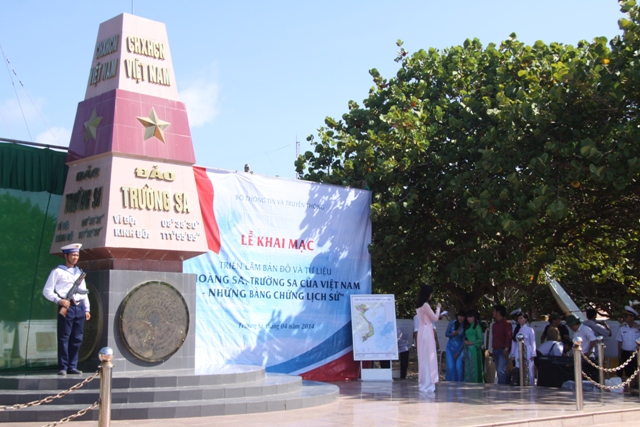
The Vietnamese sovereignty stele on Song Tu Tay Island, part of the Truong Sa (Spratly) archipelago in the East Vietnam Sea, was built 58 years ago.
Tuoi Tre
One of them is situated on Song Tu Tay Island and the other is situated on Nam Yet Island.

The two islands are part of Truong Sa District of south-central Khanh Hoa Province, said Truong Dang Tuyen, the director of the provincial Department of Culture, Sports, and Tourism.

The steles were built 58 years ago, in 1956, by the government of the former Republic of Vietnam, which governed the southern half of the country in the 1955-1975 period, Tuyen said.

Both of them were inscribed with the following words: “The Truong Sa archipelago is directly governed by Phuoc Tuy Province. The military mission for examination and studies   visited the archipelago on August 22, 1956 under the guidance of the Republic of Vietnam Navy.”

“In April 1956, when the French expeditionary troops withdrew from Indochina, the Vietnamese national army, which later became the Republic of Vietnam Army governed the western part of the Hoang Sa [Paracel] archipelago,” said Dr. Tran Cong Truc, former head of the current government’s National Border Committee.

In this transitional time, China invaded a number of islands of both Truong Sa and Hoang Sa, and the Republic of Vietnam voiced its protest against China’s invasion, Truc said.

“On May 24 and June 8, 1956, the Republic of Vietnam issued a notice, emphasizing that Truong Sa and Hoang Sa ‘are always integral parts of Vietnam’ and affirming Vietnam’s long-standing sovereignty over the archipelagos,” the former official said.

Truc also noted that “on August 22, 1956, naval ship HQ04 of the Republic of Vietnam arrived in Truong Sa to build the sovereignty steles, erect the flag poles, and take measures to protect the archipelago from the illegal occupation and violation of Vietnam’s territorial integrity by some countries.”

Later, on October 20, 1956, the Republic of Vietnam issued Decree 143/Vietnam to put the Truong Sa archipelago under the administration of Phuoc Tuy Province, the ex-official added.

In 2011, the Khanh Hoa People’s Committee recognized the two steles in Truong Sa as provincial historical relics.

Nguyen Viet Thuan, chairman of the Truong Sa District People’s Committee, said the authorities, army and people of the district are very happy to know the two steles have been acknowledged as national historical relics.

The provincial authorities have assigned their Department of Culture, Sports, and Tourism to coordinate with the district authorities and the Vietnam People’s Navy to set up a plan to embellish the two relics.

Tuoi Tre (Youth) newspaper’s Editorial Board and the provincial People’s Committee has reached a consensus that the embellishment of the steles will be funded by an ongoing program initiated by the paper to raise money for Truong Sa,” said Truong Dang Tuyen, director of the provincial Department of Culture, Sports, and Tourism.

“We are building a plan for the embellishment and will submit it to the provincial authorities for consideration in the coming time,” Tuyen said.

Top Chinese diplomat Yang Jiechi visits Vietnam over oil rig

05:35 |
Chinese State Councilor Yang Jiechi met Vietnamese Foreign Minister and Deputy Prime Minister Pham Binh Minh at the government's guest house in Hanoi on Wednesday.
UOI TRE
UPDATED : 06/18/2014 15:01 GMT + 7

The two countries’ top diplomats were expected to have direct talks about the oil rig Haiyang Shiyou 981 that Beijing has illegally placed in Hanoi waters in the East Vietnam Sea since May 1.
Yang's visit is the highest-level direct contact between the two sides since the drilling platform was towed into Vietnam’s 200-nautical-mile exclusive economic zone and continental shelf.
This meeting is believed to be geared to find solutions for tensions in the sea area.
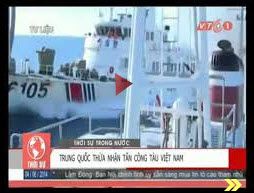
Over the last one month and a half, China has deployed a huge number of vessels, including big iron-clad fishing boats, to guard its oil rig and attack Vietnamese vessels, including fishing boats. 
China’s large iron-clad fishing boats have rammed a dozen Vietnamese fishing boats in the waters, injuring several fishermen, and damaging their vessels.
Notably, on May 26, Chinese vessel #11209 slammed into and sank Vietnamese fishing boat DNa 90152 with ten crew members aboard. All the Vietnamese fishermen were rescued by another Vietnamese fishing boat the same day.
Chinese State Councilor Yang Jiechi (L), who outranks the Chinese foreign minister Wang Yi, shakes hands with Vietnamese Deputy Prime Minister and Foreign Minister Pham Binh Minh during their meeting at the government's guest house in Hanoi on June 18, 2014. Photo: Tuoi Tre
Chinese State Councilor Yang Jiechi was present at the Vietnamese government's guest house in Hanoi to have talks with Vietnamese Deputy Prime Minister and Foreign Minister Pham Binh Minh at 9:30 am on June 18, 2014. Photo: Tuoi Tre
Delegates from the two sides were expected to have direct talks about Beijing’s oil rig Haiyang Shiyou 981 that has been illicitly positioned in Vietnamese waters since May 1. Photo: Tuoi Tre
Vietnamese Deputy Prime Minister and Foreign Minister Pham Binh Minh (second right) is pictured at the meeting with Chinese State Councilor Yang Jiechi (not seen) at the government's guest house in Hanoi on June 18, 2014.Photo: Tuoi Tre
Chinese State Councilor Yang Jiechi (first left) is seen at the meeting at the government's guest house in Hanoi on June 18, 2014. Photo: Tuoi Tre

  1. 54-year-old Chinese State Councilor Yang Jiechi, who outranks the Chinese foreign minister Wang Yi, met Vietnamese Deputy Prime Minister and Foreign Minister Pham Binh Minh for the first time during their meeting at the government's guest house in Hanoi on June 18, 2014. Photo: Tuoi Tre

China towing second oil rig to East Vietnam Sea amid tensions

05:32 |
China has dispatched another oil rig, Nan Hai Jiu Hao, to the East Vietnam Sea after illegally placing the Haiyang Shiyou 981 drilling platform in Vietnamese waters since May 1, despite strong protest from Vietnam.
TUOITRENEWS
UPDATED : 06/19/2014 11:35 GMT + 7


In a notice on its website on June 17, the Chinese Maritime Safety Administration (MSA) said the new rig would be towed between June 18 and 20 by a tugboat from its existing location, at 17°38' North latitude and 110°12.3' East longitude, to the new location at 17°14.1' North latitude and 109°31' East longitude in the East Vietnam Sea. 

The new location is near Vietnam’s Hoang Sa (Paracel) archipelago, a news website of Hong Kong-based Phoenix Television, ifeng.com, reported on June 18.

It is unknown how long the second rig, which is owned by China National Offshore Oil Corporation (CNOOC), will be placed in the East Vietnam Sea, according to ifeng.com.

As shown on the map, Nan Hai Jiu Hao is to be located in the area off the mouth of the Gulf of Tonkin.

Vietnam and China are negotiating to fix a line to delineate the maritime boundary between the two countries in this gulf.     

Nan Hai Jiu Hao, a semi-submersible drilling rig, is 600 meters long and weighs 21,714 tons. It moves at four nautical miles per hour, the MSA said.

The towing of the second platform followed the visit of Chinese State Councilor Yang Jiechi who arrived in Vietnam on Wednesday to discuss the first rig issue and bilateral cooperation. 

Yang left the country the same day after meeting with high-ranking Vietnamese officials in Hanoi.

At the talk with Yang yesterday, Vietnamese Prime Minister Nguyen Tan Dung affirmed that by placing the Haiyang Shiyou 981 rig in the Vietnamese waters around Hoang Sa, China has seriously violated Vietnam’s sovereignty and the agreements reached between leaders of both countries as well as broken international law, the 1982 United Nations Convention on the Law of the Sea (UNCLOS), and the Declaration on the Conduct of Parties in the East Vietnam Sea (DOC).

PM Dung requested that China remove its rig and escorting ships from Vietnam’s waters and join talks for the settlement of disputes and differences between the two countries by peaceful measures based on international law and the common perception of the two countries’ leaders.

Earlier the same day, at a meeting with the Chinese official, Deputy Prime Minister and Foreign Minister Pham Binh Minh firmly asserted Vietnam’s sovereignty over Hoang Sa as well as its sovereign right and jurisdiction over the exclusive economic zone and continental shelf as defined by the 1982 UNCLOS to which both Vietnam and China are signatories.

The Deputy PM demanded that China withdraw its rig and guardian ships from Vietnam’s waters, control the situation to prevent conflicts, and join talks for the settlement of current tensions.

Vietnam rejects China’s East Sea wrongful allegations

02:24 |
The Ministry of Foreign Affairs held an international press conference in Hanoi on June 16 to clarify China’s wrongful, groundless allegations of the current situation in the East Sea made on June 13 and provide fresh developments there. 

Vice Chairman of the National Boundary Commission Tran Duy Hai stated that Vietnam has made every effort and shown every gesture of goodwill to solve the current tension in the East Sea, which was sparked by China’s illegal placement of its oil rig Haiyang Shiyou-981 in Vietnam’s waters, via negotiations and peaceful solutions but China has responded in an unconstructive manner. 

China has not only failed to respond to Vietnam’s goodwill but come up with baseless accusations that have distorted the facts and slandered Vietnamese ships of ramming against Chinese vessels more than 1,500 times, he said, adding that China has not provided any real proof to support its accusations. 

Meanwhile, according to Hai, Vietnam has publicised many pieces of evidence, by photos and video clips, capturing China’s aggressive, violent acts such as ramming against and firing water cannons at Vietnam’s ships, sinking a Vietnamese fishing boat, and injuring tens of Vietnamese people. 
“Once again, Vietnam resolutely demands China respect international law, immediately stop violations of the sovereign right and jurisdiction of Vietnam in its exclusive economic zone and continental shelf, withdraw the Haiyang Shiyou-981 oil rig and escort vehicles from Vietnam’s waters, and never repeat similar acts in the future,” he stressed. 

Vietnam continues to request China to solve all disputes through peaceful means in accordance with international law, including the 1982 UN Convention on the Law of the Sea (UNCLOS), he added. 

Nguyen Quoc Thap, Deputy General Director of the Vietnam National Oil and Gas Group, declared that it is completely groundless and void for China to state that Vietnam ’s 57 oil and gas lots are in disputed waters basing on its “U-shaped line” claim that was not recognised internationally. 

He added that China is intentionally turning undisputed areas into disputed ones with reasonless claims. 

In fact, these lots are totally within Vietnam’s 200-nautical mile continental shelf and exclusive economic zone, he affirmed. 

This is not the first time China has conducted illegal activities violating Vietnam’s waters. Vietnam has opposed China’s previous violations via the diplomatic channel along with protesting in the field and launching communication campaigns to make it understand and not repeat similar violations. 

Regarding the current situation at the site, Ngo Ngoc Thu, Deputy Commander of the Vietnam Coast Guard High Command, confirmed that Vietnam has not sent any frogmen to the site nor dropped any object there. 

Nets and floating things fished out by Chinese ships were those left by Vietnamese fishing boats operating normally in Vietnam’s waters escaping from intimidation of Chinese vessels, said Thu. 

Debris that were collected and brazenly claimed as evidence by the Chinese side were fragments from Vietnamese boats after being rammed and fired high-pressure water cannon at by Chinese ships, he added. 

Although Chinese ships have kept on violently blocking, ramming and firing water cannons at Vietnamese ships, Vietnamese coast guard and fisheries surveillance authorities still practised utmost restraint, trying to avoid any clash with Chinese ships. 

Vietnamese vessels have not fired water cannons back at Chinese ships, but only used spoken words to demand China remove its rig and all defending vessels from Vietnam’s waters, noted Thu. 

According to Ha Le, Deputy Head of the Vietnam Fisheries Surveillance Department, Vietnamese fisheries surveillance ships at the site continued to keep calm and managed to shun clash with Chinese ships. 

They also persistently used all peaceful measures to request China withdraw from Vietnam’s waters that it is violating, he said. 

Vietnamese ships will continue their law enforcement missions at sea, resolutely protecting the national sovereignty and safeguarding fishermen in their traditional fishing grounds, Le added.-VNA

UN ready to mediate in Vietnam-China row: spokesman

05:37 |

TUOITRENEWS
UPDATED : 06/12/2014 14:25 GMT + 7
The United Nations has said that it is ready to help settle a maritime dispute between Vietnam and China if both sides ask the UN to do so, Japan's national broadcaster NHK reported.   


UN spokesman Stephane Dujarric said on Tuesday that UN Secretary General Ban Ki-moon would be ready to mediate if the parties involved request UN mediation, NHK said.

The head of the UN has also expressed hopes that the dispute will be resolved peacefully and in accordance with international law,NHK quoted Dujarric as saying.

The UN’s announcement came after China illegally deployed oil rig Haiyang Shiyou 981 and a large number of vessels to guard the platform within Vietnam’s 20-nautical-mile exclusive economic zone and continental shelf on May 1.

Also on Tuesday, President of the UN General Assembly John Ashe met with Vietnamese Permanent Representative to the UN Ambassador Le Hoai Trung at the UN Office in New York to discuss China’s illegal rig deployment.

Ambassador Trung told Ashe that Vietnam has full historical and legal evidence to prove its sovereignty over the Hoang Sa (Paracel) archipelago in the East Vietnam Sea.

Trung also rejected wrong and fabricated information in a report that China sent to the UN on Monday in relation to the rig.

The information and arguments in the report are untrue and not based on any international legal foundation, the ambassador told the UN president.

Trung also emphasized that China has seriously violated Vietnam’s sovereign rights and jurisdiction over its exclusive economic zone and continental shelf stipulated by the 1982 United Nations Convention on the Law of the Sea (UNCLOS), to which both Vietnam and China are signatories.

China has also infringed upon the Declaration of the Conduct of Parties in the East Vietnam Sea, threatening the peace, stability, and maritime safety and security in the region.

Meanwhile, President Ashe expressed his deep concern over the situation in the East Vietnam Sea and supported Vietnam’s policy to resolve the issue through peaceful means based on the UN Charter and international law, Radio Voice of Vietnam (VOV) reported Wednesday.

The UN President also said the parties concerned should not take any unilateral action that would escalate the tension, and that he is willing to help the parties ease the conflict, VOV said.

Meanwhile, UN spokesman Stephane Dujarric called for both sides to resolve the dispute peacefully and legally, according to BBC.

In a recent e-mail to Tuoi Tre (Youth) newspaper, Bonnie Glaser, an analyst at the U.S.-based Center for Strategic and International Studies (CSIS), said China is worrying about its international prestige after it was accused by many countries in the region and the U.S. of being the attacker in the East Vietnam Sea.

She also said China does not want to be considered a country that often violates international law.

Chinese diplomat to discuss illegal oil rig in Vietnam visit

05:28 |
Tuesday, June 17, 2014 14:32 
  1. Chinese State Councilor Yang Jiechi shown in a file photo
  2. Deputy Prime Minister Pham Binh Minh and China's State Councilor Yang Jiechi will discuss the oil rig that China illegally placed into Vietnamese waters when they meet at an annual bilateral event this week, Foreign Ministry spokesman Le Hai Binh told reporters on Monday.
  3. Binh said at an international press conference on developments in the East Sea (internationally known as South China Sea) that Yang will arrive in Vietnam for a meeting of the Steering Committee on Vietnam-China Bilateral Relations, of which he and Minh are chairmen.
"As we have affirmed many times, Vietnam has always patiently sought dialogue with China to peacefully resolve the tension in the East Sea," Binh said. "This meeting, therefore, will surely provide a channel for the two sides can discuss the issue to find out solutions for the current tension."
Yang's visit will be the highest-level meeting between the two governments since the US$1-billion Haiyang Shiyou-981 oil rig was deployed earlier last month.

Trung Son
Thanh Nien New

Vietnam slams China’s distortion of East Sea situation

05:23 |
Tuesday, June 17, 2014 15:02 
The Ministry of Foreign Affairs held a press conference on East Sea developments in Hanoi on June 16, 2014. Photo: Ngoc Thang
The Ministry of Foreign Affairs rejected China’s allegations that Vietnamese ships have deliberately collided with the protective armada guarding its illegally positioned oil rig as groundless and without evidence during an international press conference held Monday in Hanoi.
Tran Duy Hai, vice chairman of the National Boundary Commission, announced that Vietnam has made every effort to peacefully resolve the current tensions in the East Sea, which arose when China illegally positioned the Haiyang Shiyou-981 oil rig in Vietnamese waters.
The Foreign Ministry has stressed that it has repeatedly sought to peacefully negotiate with the Chinese, but they have responded in an unconstructive manner.
China has promulgated baseless accusations that falsely charge Vietnamese ships with having rammed Chinese vessels more than 1,500 times, he said, adding that China has not provided any evidence to support its accusations.
According to Hai, Vietnam has released photos and video clips capturing China’s aggressive, violent acts such as ramming and firing water cannons at Vietnam’s ships, sinking a Vietnamese fishing boat, and injuring dozens of Vietnamese crew members.
When asked to comment on photos and clips which show Chinese ships with broken prows after being allegedly attacked by Vietnamese vessels, Ngo Ngoc Thu, vice commander of the High Command of Vietnam Coast Guard, said a ship's prow cannot be broken can only be damaged in an offensive attack.
He also rejected China’s accusations that Vietnam has sent frogmen to the oil rig and placed objects to hinder Chinese navigation near the rig.
“We can confirm that Vietnam has never used frogmen at the site of the Haiyan Shiyou-981 oil rig.
“Nets and floating objects fished out by Chinese ships were jettisoned or lost by Vietnamese fishermen as they were trying to flee advancing Chinese vessels.”
The Chinese have absurdly presented its collection of flotsam as evidence of sabotage; in fact, it's the broken pieces of the Vietnamese boats that they rammed and blasted with high-pressure water cannons, he added.
Although Chinese ships have continued to violently block, ram and blast Vietnamese ships, Vietnamese coast guard and fisheries surveillance forces have abstained from responding with violence, Thu said.
Vietnamese vessels have not fired water cannons back at Chinese ships, but instead used loudspeakers to demand China remove its rig and protective armada from Vietnam’s waters, noted Thu.
Ha Le, vice head of the Vietnam Fisheries Surveillance Department, told reporters China has sent 50 armored boats to Hoang Sa (Paracel) Islands, but not for fishing.
The boats joined Chinese army ships to ram and damage Vietnamese fishing boats and attack Vietnamese fishermen who were fishing in their customary spots, he said.
Since May 1, 17 Vietnamese fishing boats have been damaged and dozens of Vietnamese fishermen injured (three of whom seriously) in hundreds of attacks made by Chinese forces, according to Le.
When asked to comment on Chinese foreign ministry’s request on June 13 that Vietnam withdraw from 29 islets and shoals in the Truong Sa (Spratly) Islands which China claims Vietnam occupied, Hai (vice chairman of the National Boundary Commission) said the request was absolutely unreasonable.
“We reject the request. Vietnam has all legal and historical evidence to affirm its sovereignty over Truong Sa Archipelago; Vietnam has consistently managed and explored the islands in a peaceful way.
“It is China who used force to occupy shoals in Truong Sa, so China must withdraw from the shoals it had illegally occupied since 1988.”

Truong Son

  1. Thanh Nien News

Sovereignty cannot be occupied by force

10:57 |
VietNamNet Bridge - "Sovereignty must be peacefully established and exercised by the State, without dispute, absolutely not sovereignty seized by force," said Prof. Dr. Nguyen Quang Ngoc, the chair of the Council for Appraisal of Artifacts, Historical and Legal Evidence for Vietnam’s Sovereignty over the Paracel and Spratly Islands.
Ample evidence


sovereignty, evidence, ancient maps, atlas
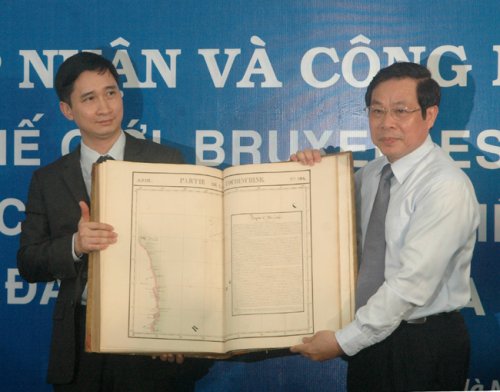
The World Atlas (Bruxelles - 1827) by the eminent geographer Philippe Vandermaelen (1795-1869), member of the Paris Geographical Society, includes a map showing that the Paracel Islands belong to Vietnam.


Prof. Dr. of History Nguyen Quang Ngoc was one of the first members of the Council for Appraisal of Artifacts, Historical and Legal Evidence for Vietnam’s Sovereignty over the Hoang Sa (Paracel) and Truong Sa (Spratly) Islands.
He has long been completing the tasks of assessment, decoding artifacts, compiling historical and legal evidence and arranging them to serve as basis for exhibitions on the Hoang Sa - Truong Sa islands held by the Ministry of Information and Communications.
Ngoc said there is much legal evidence that affirms Vietnam's sovereignty over the two archipelagos of Hoang Sa - Truong Sa, including important and vivid evidence contributed by ordinary people.
Ngoc said the first exhibition of this type was organized by Da Nang City named "Hoang Sa - Truong Sa Documents," mainly the documents about Hoang Sa. The documents are part of ta research project by Dr. Tran Duc Anh Son and some overseas Vietnamese. They include a number of Western maps and Western atlases about China.
When the External Information Department of the Ministry of Information and Communication organized the national exhibition on Hoang Sa - Truong Sa, Mr. Ngoc was invited as the chair of the document evaluation council, which consisted of many experts from the Government Boundary Committee, the Ministry of Science and Technology, the Center for Marine and Maritime Research, the Mapping Bureau, and others.
The Council decided to choose historic Western maps collected by Dr. Tran Duc Anh Son, the Western Atlas about China that had recently been collected in the US, and some old maps and documents of Vietnam, particularly documents called “Chau Ban” (administrative documents of the royal court) as the exhibits in the national exhibition on Vietnam’s sovereignty over Hoang Sa in the central province of Ha Tinh. The exhibition was a big success.
After each exhibition, the organizers received opinions and materials from the public to enrich their objects, documents and evidence for the next exhibition.
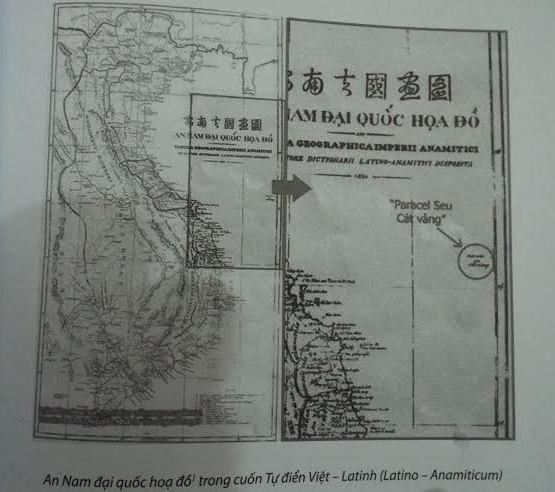
At the exhibition in Thai Nguyen, the organizers added photos of historic maps of the West, proving Vietnam’s sovereignty over Hoang Sa and Truong Sa. These are the photos of the original maps, so the quality is very good, Ngoc said. According to Ngoc, these photos were taken by Dr. Tran Duc Anh Son in France. Among them is a map by Taberd in 1838.
sovereignty, evidence, ancient maps, atlas 
The birth certificate of a citizen on the Paracel Islands, provided by the people, for an exhibition held by the Ministry of Science, Technology and Environment in Ho Chi Minh City.
Ngoc said the amount of evidence, both historical and legal, of Vietnam’s sovereignty over Hoang Sa and Truong Sa, is huge. In terms of ancient maps alone, there are several hundred old maps of the West but the council only chose several dozen of the maps for exhibitions. There are also many valuable “chau ban”, particularly those of the Nguyen Dynasty (1802-1945).
Ngoc said sovereignty is national sovereignty, ie sovereignty that is established and enforced by the State in conditions of peace, without dispute, absolutely not sovereignty seized by force, or sovereignty of individuals or factions. Therefore, documents of the state or “chau ban” are the most appreciated in regards to legality.
He emphasized that the “chau ban”, including the reports of ministries and agencies to the emperor on sending boats to Hoang Sa to map and collect marine resources, are unique documents that only Vietnam has. These documents are highly praised for their legal value over Vietnam’s sovereignty of Hoang Sa and Truong Sa.
Di Linh

Ancient records show Vietnam’s sovereignty over Hoang Sa - Truong Sa

10:50 |
VietNamNet would like to introduce a series of articles on ancient documents proving Vietnam’s sovereignty over the archipelagos of Hoang Sa (Paracel) and Truong Sa (Spratly).
Part 1: The earliest records


ancient documents, evidence for sovereignty, hoang sa, bai cat vang
The map of An Nam by French priest Jean-Louis Taberd.


Vietnam has the oldest historic documents about the Paracel and Spratly Islands in the world, starting from the early 17th century.
Hoang Sa was called by westerners as “Paracels” in the 19th century. Documents by Western researchers, missionaries and merchants all described Paracels as a series of islands, rocks and coral reefs along the central coast of Vietnam.
Until the 18th century and a long time after that, Vietnamese geographers and the western navigators did not distinguish Paracel as the two archipelagos of Hoang Sa and Truong Sa as today.
For Vietnamese people, the name Hoang Sa, Bai Cat Vang, Dai Truong Sa or Van Ly Truong Sa referred to the islands stretching from the north to south East Sea. By early 20th century, the above names were still used. In royal document No. 10 in 1933 of King Bao Dai and the Ordinance No. 143 by President Ngo Dinh Diem in 1965, Hoang Sa (Paracels) was still used as the name for the both archipelagos of Hoang Sa and Truong Sa.
Doctor of history Nguyen Nha and his European colleagues have discovered a very interesting detail: The Chinese in ancient and medieval ages were not interested in the sea. For them, the territory was called "江山" or "mountains and rivers", understood in the modern language as the mainland.
For the Vietnamese, territory had a broader sense, as “dat nuoc” (water and land) in Vietnamese. In the minds of the Vietnamese people, "dat nuoc" is a country including the mainland and islands.
However, the French were the first who distinguished the two archipelagos by two different names. The French’s historic documents show that Paracels or Hoang Sa is in the north and Spratley is in the south.
By the 1970s, the names of the two archipelagos were used uniformly and popularly.
In general, though the names are different, but in the ancient documents of Vietnam like “Dai Nam Thong Nhat Toan Do" (大南ー統全)(The Map of United Dai Nam), which was compiled in the Nguyen Dynasty in 1838 and “Bac Ky Hoi Do” (maps of the northern Vietnam), Hoang Sa and Truong Sa were drawn as a series of islands from north to south.
Hoang Sa - Truong Sa in feudal history


ancient documents, evidence for sovereignty, hoang sa, bai cat vang
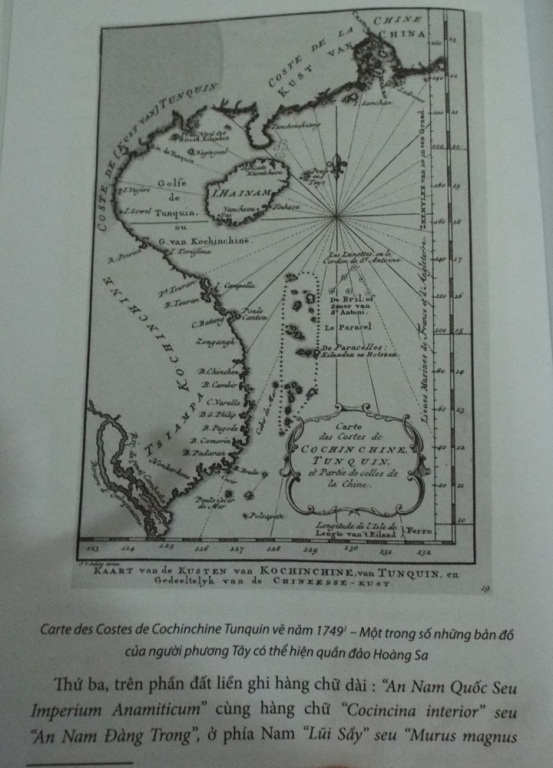
The map published in 1749 by western navigators (Carte des Costes de Cochinchine Tunquin) , with Hoang Sa as Vietnam's territory.


To date, the oldest document that provides the most detailed description of Hoang Sa is the book “Phu Bien Tap Luc” (Miscellaneous Chronicles of the Pacified Frontier, 1776) by well-known Vietnamese historian Le Quy Don. This is a six-volume Chinese-language geography. It is a detailed description of the Nguyen dynasty's territories in Thuan Hoa and Quang Nam Provinces, and covers the outlying areas such as Hoang Sa.
Page 78 b and 79 a read as follows: “An Vinh Commune, Binh Son District, Quang Ngai Prefecture has a mountain [5] outside its seaport called Re Island, which is 30-li wide. It takes four watches to reach the island, on which there is a ward named Tu Chinh with bean-growing inhabitants. Further offshore are the Dai Truong Sa Islands, where there are plenty of sea products and other goods. It takes the Hoang Sa Flotilla, founded to collect those products and goods; three full days to reach the islands, which are near Bac Hai.”
“… Bình Son District of Quang Ngai Prefecture includes the coastal commune of An Vinh. Offshore to the northeast of An Vinh are many islands and approximately 130 mountains separated by waters which can take from few watches to few days to travel across. Streams of fresh water can be found on these mountains. Within the islands is a 30-li long, flat and wide golden sand bank, on which the water is so transparent that one can see through. The islands have many swift nests and hundreds or thousands of other kinds of birds; they alight around instead of avoiding humans. There are many curios on the sandbank. Among the volutes are the Indian volutes. An Indian volute here can be as big as a mat; on their ventral side are opaque beads, different from pearls, and are as big as fingertips; their shells can be carved to make identification badges or calcined to provide lime for house construction. There are also conches that can be used for furniture inlay, and Babylon shells. All snails here can be salted for food. The sea turtles are oversized. There is a sea soft-shell turtle called “hai ba” or “trang bong”, similar to but smaller than the normal hawksbill sea turtles; their thin shell can be used for furniture inlay, and their thumb-sized eggs can be salted for food. There is a kind of sea cucumbers called “dot dot”, normally seen when swimming about the shore; they can be used as food after lime treatment, gut removal and drying. Before serving “dot dot”, one should process it with freshwater crab extract and scrape all the dirt off. It will be better if cooked with shrimps and pork.
He also wrote: “Foreign boats often take refuge in these islands to avoid storms. The Nguyen rulers have established Hoang Sa Flotilla with 70 sailors selected from An Vinh commune on a rotation basis. Selected sailors receive their order in the third month of every year, bring with them sufficient food for six months, and sail on five small fishing boats for three full days to reach the islands. Once settled down on the islands, they are free to catch as many birds and fish as they like. They collect goods from boats passing by, such as sabers, jewelries, money, porcelain rings, and fur; they also collect plenty of sea turtle shells, sea cucumbers, and volute shells. The sailors return to mainland in the eighth month through Eo Seaport. On their return trip, they first sail to Phu Xuan Citadel, where the goods that they have collected shall be submitted to be measured and classified; they can then take their parts of volutes, sea turtles, and sea cucumbers for their own trading businesses, and receive licenses before going home. The amount of collected materials varies; sometimes the sailors could not collect anything at all. I have personally checked the notebook of the former flotilla captain Thuyen Duc Hau, which recorded the amount of collected goods: 30 scoops of silver in the year of Nham Ngo (1762), 5,100 catties of tin in the year of Giap Than (1764), 126 scoops of silver in the year of At Dau (1765), a few sea turtle shells each year from the year of Ky Suu (1769) to the year of Quy Ty (1773). There were also years when only cubic tin, porcelain bowls, and two copper guns were collected.
The Nguyen rulers also established Bac Hai Flotilla without a fixed number of sailors, selected from Tu Chinh Village in Binh Thuan or from Canh Duong Commune. Sailors are selected on a voluntary basis. Those who volunteer to join the flotilla will be exempted from poll tax, patrol and transportation fees. These sailors travel in small fishing boats to Bac Hai, Con Lon Island, and other islands in Ha Tien area, collecting goods from ships, and sea products such as turtles, abalones, and sea cucumbers. Bac Hai Flotilla is under the command of Hoang Sa Flotilla. The collected items are mostly sea products and rarely include jewelries.”
To be continued…
Duy Chien
* The article uses research materials by Dr. Han Nguyen Nguyen Nha, founder and advisor of the Cultural Education Fund in HCM City.
Được tạo bởi Blogger.

Biển Đông News

Template Information